
Learning With HubSpot

I’ve said before that I’m a big fan of Nelson Mandela’s quote: “I never lose. I either win or learn.” We’ve been doing a lot of winning lately, which is always nice, but mistakes can be valuable for helping to find what you may be doing wrong so you can improve and avoid it the next time around.
Talking about losers isn’t exactly marketing 101 but I originally viewed this substack as at least partly educational in nature. If I was to start over with limited knowledge, this is the sort of stuff I’d really want to know. In this case, I want to talk about HubSpot (HUBS) a stock we recently bought that fell about -19% after earnings.
What happened? Nothing too big, to my mind. The quarter was great, but the guidance didn’t follow through. Instead, revenue guidance was pretty unmoved for the rest of the quarter, though earnings guidance rose. To my mind, that’s a conditional problem-- what’s priced in? How much tolerance is there for a miss?
The first ‘mistake’ is here. I put ‘mistake’ in quotes because it was intentional. If this was in a popular area like semiconductors and the valuation wasn’t overly stressed, a miss like that wouldn’t be a big deal. We can see that in action on the same day, with data center company IREN up 8% despite missing revenue. Instead, HUBS is a hated software company, so any miss can be pounced on.
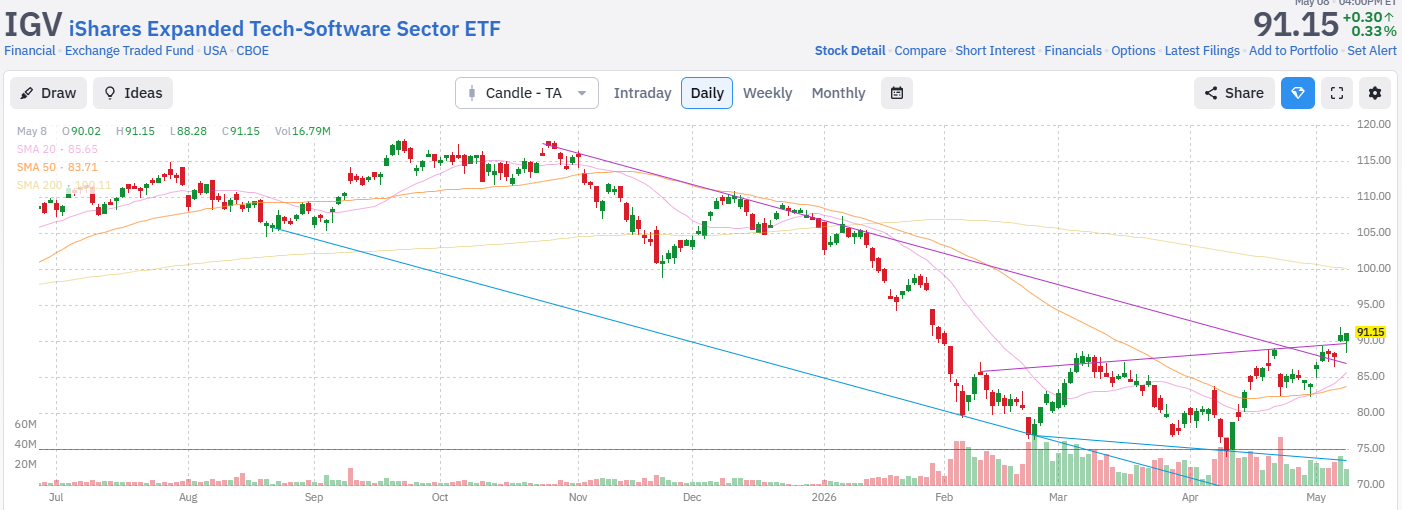
Why would I invest in a hated area? I do that very cautiously and only when I think the area can work and downside is largely over. In this case, the software (IGV) industry appears to have bottomed. Short interest has collapsed, as has implied volatility, which can be considered a fear gauge. That seemed like a high percentage shot into earnings that were likely to be constructive.
Instead, HUBS and some other high beta stocks were punished severely for what seemed like gentle misses. Were there clues? For one, the market has seen low correlation, meaning there’s been a wide dispersion of returns. Thus, stocks are more free to follow their own path, rather than market direction. For another, we’ve seen a powerful rally, including HUBS, which had already climbed about 20% off of lows seen last month. That makes reversion, the stock going back down, more possible.
To be fair, we didn’t buy the day before earnings. We’d already made about 7% on our purchase, before Friday’s decline. Looking over the recent rally in HUBS, it looks like many shared our sentiment, with options skewed towards calls rather than puts, and the stock was still well off the over $800 share price it saw last year. Many shared our upside thoughts.
Honestly, I view the purchase as a calculated risk. Many seemed to agree with us that the stock could have been up 19% rather than down that much post-earnings. In this case, we seem to have pressed our luck one too many times on this rally. We thought we could roll a 3 or higher on a six-sided die, and we rolled a 1. With stocks, the odds can be with you, and you can still lose. It happens.
As it is, we currently have a -13% loss on the stock. Not great but not the end of the world. It’s encouraging that a lot of calls were bought on the day, while HUBS opened on the lows and closed on the highs. I don’t see anything very concerning in the report and apparently others also believe that. I still think there’s likely to be a very good future for HUBS. Should we buy more? That’s a tougher call, as I didn’t position our initial buy size with an idea of expanding it. In retrospect, that probably would have been a good idea.
So, what can we learn, here? Investing isn’t an easy game. Sometimes you take a calculated risk and lose. As markets move up, future return potential goes away. With randomness involved, finding that line of where to stop can be very difficult. Honestly, if I could do this situation over again, I’d definitely invest again, just perhaps in a smaller initial size, in case it didn’t work out. I still expect HUBS to work out for us, though, just not in exactly the path I was hoping for.