
On Positioning
Positioning has a lot to say about future direction

I was going to write about positioning anyway, as it complements the carry trade post from yesterday. The attack on Iran, however, is also a good example of how positioning affects returns. Admittedly, it probably shouldn’t be a shock, but how people position out of concern for an event can greatly shift how we react to that event.
To stick to the war theme, classically, war doesn’t just come out of nowhere. Worries about war can start well before any missiles fly. To keep it short and sweet, the first Gulf War, Operation Desert Storm of 1990-1991, stocks started dropping about a month before Iraq invaded Kuwait. That continued as the US got their air defenses in place, leading to -18% losses until the US prepared for a land an air campaign, sending stocks back up.
Similarly, the Second Gulf War, for which the US was better prepared, still saw a -11% decline as worries about a prolonged conflict and oil shock created concern. However, nine days before the invasion even started, the market started going up. With both wars, stocks saw initial declines and strong recoveries, once concerns faded.
This time, we didn’t get much of an overall decline (perhaps because the setup was friendlier,) but breadth struggled and volatility remained elevated as war concern persisted. Today, many are surprised that the market is holding up so well. To some extent, the 19th century saying attributed to Rothschild, “Buy on the sound of cannons, sell on the sound of trumpets” is in effect, here.
How does that work? Positioning. People worry about war, so they hedge and sell. Eventually, the slightest good news can take stocks up. In this particular case, I’d said that the market seemed over-hedged into a potential event. Thus, you’d need something pretty bad to keep markets down.
That said, it’s not like we have to just go straight up. Every war headline has a decent chance to take the market down, if only temporarily. People are nervous and will remain so for a while. For now, though, all the hedges, like silver and Treasuries, are getting hit, as the hedging fades. Realistically, though, the market is doing what it usually does, seeking out the next band of resistance, in this case, around 6900.
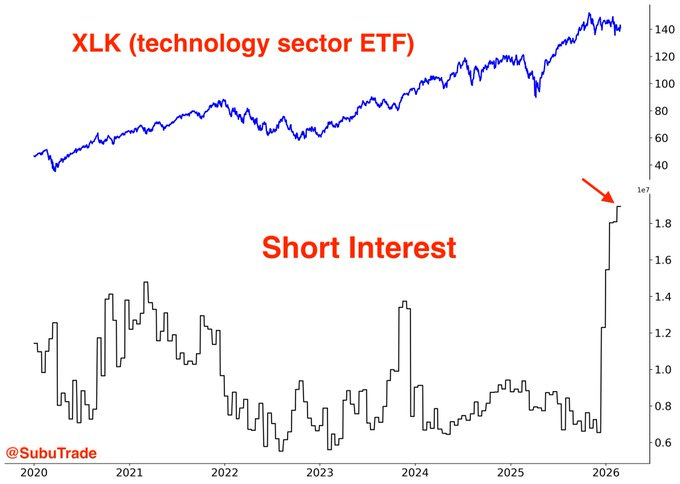
In terms of why we positioned like we are, a lot of that is also positioning. We got out of MSFT in late July because it seemed tough to beat high expectations. In early September, we bought DOW because people assumed chemical oversupply would last forever and the stock had been struggling. Lately, we’ve been buying software companies because belief AI makes them all zeroes seems greatly overwrought.
Looking at the chart above, we can see that technology has the highest short interest it’s seen this decade, despite the fact that it’s off highs and still represents the area of highest growth. We can always be wrong, but I’d rather (carefully) buy something like that instead of the latest darling that’s already up 25%, particularly once implied volatility started to relax.
So where are we now? There’s no guarantees, of course. Assuming the Iranian conflict doesn’t become much worse than expected, I’d say we just have the usual worries, like the jobs market and inflation. In the meantime, shorts and the underinvested are likely to need to dive in. It’s very early but I’m currently feeling pretty good about our choice to own software and growth. The market is likely to stay nervous for a while, but it’s a good sign that we’re holding up well.